
Flipping Houses vs. New Construction Loans: What’s the Difference?
Jacob Shimon is a professional finance writer at eBoost Partners with over seven years of experience in the commercial lending industry. A graduate of the University of Florida’s Warrington College of Business with a degree in Finance, he specializes in breaking down complex business lending topics to help entrepreneurs make smart, informed decisions.
We’ve all seen the shows. You buy a 1970s ranch with shag carpet and a weird smell, knock down a wall, paint everything white, and boom – you pocket $50,000 in six weeks.
Or maybe you dream bigger. You see that empty lot on the corner of Main Street and think, “I could build a duplex there.”
Real estate investment is the classic American path to wealth. But here’s the thing that HGTV doesn’t usually show you: the financing paperwork. The money you need to slap some paint on a fixer-upper is completely different from the capital required to pour a foundation and frame a roof.
Choosing the wrong loan structure is the fastest way to kill your profit margin. I’ve seen investors try to use a short-term flip loan for a ground-up build, only to run out of time (and money) when the permitting office delayed them for three months.
At eBoost Partners, we fund both the dreamers and the builders. Whether you need $50,000 for a quick cosmetic rehab or $2M to break ground on a spec home, understanding the difference between these two financing beasts is critical. Let’s break it down.
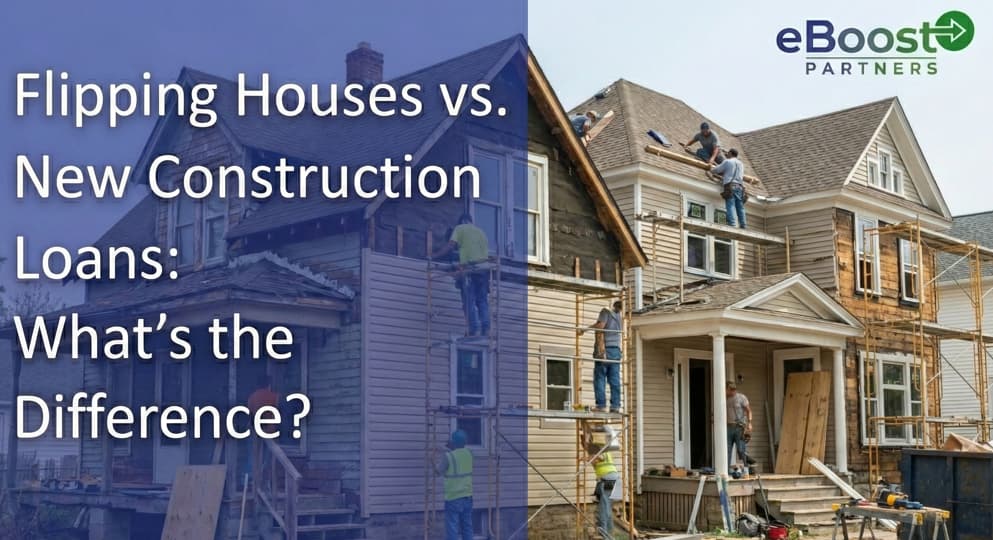
Overview: Fix-and-Flip vs. New Construction
Think of it this way:
A Fix-and-Flip is a rescue mission. You are taking a distressed asset that already exists and bringing it back to life. The bones are there; you’re just fixing the skin and muscle.
New Construction is a creation story. You are taking raw dirt and turning it into a house. The upside is often higher, but the road is longer and rockier.
Both strategies require real estate business loans, but the lenders view the risks differently.
What Is a Fix-and-Flip Loan?
This is essentially a bridge loan. It’s short-term financing designed to help you buy a property, renovate it, and sell it quickly.
Because the property is usually in bad shape (no kitchen, leaky roof), traditional mortgage lenders won’t touch it. Fannie Mae doesn’t lend on houses without working toilets. So, you turn to Hard Money or private lenders who see the potential, not just the mess.
How Fix-and-Flip Loans Work
The lender focuses on the ARV (After Repair Value). If you buy a house for $100k and plan to put $50k into it, but it will be worth $250k when done, the lender lends based on that $250k number.
You submit a detailed Scope of Work (SOW) – a line-by-line budget of what you plan to fix. The lender holds the renovation money in escrow and releases it in “draws” as you complete the work.
Typical Uses
- Cosmetic updates (paint, flooring, fixtures).
- Gut renovations (new layout, new HVAC).
- Adding square footage (finishing a basement or adding a bedroom).
Pros of Fix-and-Flip Loans
- Speed: We can often close in days, allowing you to beat cash offers.
- Higher Leverage: You can often finance up to 90% of the purchase price and 100% of the rehab costs.
- Simplicity: No need for complex zoning approvals or architectural engineering (usually).
Cons of Fix-and-Flip Loans
- The “Hidden” Factor: You tear down a wall and find termites. Or outdated wiring. Or a cracked foundation. Existing homes are full of expensive surprises.
- Short Terms: Usually 12 months. If the market cools and the house sits, the interest eats your profit.
What Is a New Construction Loan?
This is for the “ground-up” projects. Whether you are building a single Spec Home (building on speculation that it will sell) or a small subdivision, this is the tool you need.
How New Construction Loans Work
This is more complex than a flip. Before you break ground, you need Entitlements & Zoning approvals. The land must be Shovel-Ready.
Lenders look at the LTC (Loan-to-Cost). They want to know the total cost of the land plus the build. They will typically fund a percentage of that cost. Crucially, these loans often include an Interest Reserve – a bucket of money built into the loan that pays the monthly interest payments for you during construction. This saves you from paying out of pocket while the house is just a wood skeleton generating zero revenue.
Typical Uses
- Building on a vacant lot.
- “Teardowns” (where you buy a shack just to demolish it and build new).
- Accessory Dwelling Units (ADUs).
Pros of New Construction Loans
- No Hidden Rot: Everything is new. You don’t have to worry about old plumbing or lead paint.
- Customization: You build exactly what the modern market wants (open floor plans, energy efficiency).
- Higher Margins: Historically, profit margins: house flipping vs. ground-up construction lean toward new builds, simply because you are creating more value.
Cons of New Construction Loans
- Permit Purgatory: You are at the mercy of the city. Delays in permitting can stall a project for months before you even start.
- Soft Costs: You have to pay architects, engineers, and surveyors. These are expensive and must be paid upfront. For more on managing these expenses, check our guide on construction loan rates.
Key Differences: Fix-and-Flip vs. New Construction Loans
| Feature | Fix-and-Flip Loan | New Construction Loan |
| Primary Metric | ARV (After Repair Value) | As-Completed Value |
| Loan Term | 6 – 12 Months | 12 – 24 Months |
| Collateral | Existing Structure + Land | Land + Future Structure |
| Funding Trigger | Purchase & Renovation | Milestones (Foundation, Framing, etc.) |
| Main Risk | Hidden Damages (Mold, etc.) | Entitlements & Weather Delays |
| Interest Type | Monthly Payment (Usually) | Interest Reserve (Often included) |
Which Loan Is Right for You?
Honesty time. Which investor are you?
Choose a Fix-and-Flip Loan If You:
- Want Velocity: You want to get in, get out, and get paid in under 6 months.
- Are a Hands-On Operator: You know how to manage contractors and keep a renovation schedule tight.
- Have Limited Capital: Flips generally require less cash upfront for soft costs than new builds.
Choose a Construction Loan If You:
- Own the Dirt: You already own a piece of land that is zoned and ready.
- Have Patience: You can handle a 4-month delay because it rained for three weeks straight.
- Want to Scale: You want to build a portfolio of new homes that attract premium buyers. (See our construction loan guide for scaling strategies).
Costs, Rates & Fees to Expect
Let’s talk numbers. Neither of these are cheap bank loans. They are specialized commercial products.
- Interest Rates: Expect rates to be higher than a standard mortgage. In 2025, rates for these loans typically range from 9% to 14% depending on your experience.
- Origination Fees: Points charged upfront. usually 2% to 4% of the loan amount.
- Draw Fees: Every time you request money from the Draw Schedule (e.g., after pouring the slab), the lender sends an inspector. That costs money ($150-$300 per inspection).
- Insurance: You will need Builder’s Risk Insurance to protect the property while it’s under construction.3 This is non-negotiable.
At Eboost, we structure our repayment terms up to 24 months with automatic daily or weekly payments. This helps smooth out the cash flow, so you aren’t hit with massive balloon payments unexpectedly.
Common Investor Mistakes
Confusing LTV and LTC
Lenders lend on different metrics. LTV (Loan-to-Value) is based on what the house will be worth. LTC (Loan-to-Cost) is based on what you spend.
Example: A project costs $500k to build but will be worth $700k. A lender offering 80% LTC gives you $400k. A lender offering 65% LTV gives you $455k. Know the difference.
Underestimating the Timeline
New investors always assume the city will approve permits in 30 days. It often takes 90. If you have a 12-month loan and permits take 4 months, you only have 8 months to build. That is a recipe for default.
Ignoring Soft Costs
Financing land and construction together is great, but don’t forget the architectural drawings, soil tests, and impact fees. These soft costs can be 15% of your budget, and many lenders won’t finance them until after they are paid.
How to Improve Approval Odds
Whether you are applying for business loans for bad credit or a prime construction loan, the fundamentals are the same.
- Track Record: Have you flipped a house before? If not, do you have a General Contractor (GC) on your team who has? Lenders bet on the jockey, not just the horse.
- Liquidity: You need cash reserves. Lenders want to see that you can pay the mortgage if the project stalls for 3 months.
- Detailed Scope of Work: Don’t just say “Renovate Kitchen – $20k.” Break it down: “Cabinets ($8k), Counters ($4k), Labor ($6k), Appliances ($2k).” Detail breeds confidence.
If you are ready to start, you can verify your eligibility on our application page.
Real estate is a game of leverage. The difference between a hobbyist and a mogul is access to capital.
Don’t let a great deal slip through your fingers because you didn’t have the cash to close. Whether you are polishing a gem or building a legacy from the ground up, we have the funding to back your vision.
Ready to break ground?
Disclaimer: The information in this article is for educational and informational purposes only and does not constitute financial advice. All funding products, rates, and terms are provided by eBoost Partners and are subject to application, credit approval, and our current underwriting criteria. Rates and terms are subject to change without notice.
FAQ: Real Estate Construction & Flip Loans
Can I use a fix-and-flip loan for major renovations?
Yes. In fact, that is where the money is. Adding a second story or blowing out the back of the house adds massive value. Just ensure your Scope of Work is detailed and approved by the lender.
Do construction loans cover land purchase?
Sometimes. We call this a “Land + Construction” loan. However, lenders typically want you to put down a significant down payment on the land (30-50%) to show you have “skin in the game.” If you already own the land, you can often use the land’s equity as your down payment.
Which loan is cheaper?
Generally, new construction loans have slightly lower rates because the asset (a new home) is considered “prime” inventory. However, the fees can be higher due to the complexity of draw inspections and fund control.
Can beginners qualify?
Yes, but do I need experience for a ground-up construction loan? Usually, lenders want to see at least one successful project. If you are a total rookie, you may need to partner with an experienced GC or accept a lower Loan-to-Cost ratio (meaning you bring more cash to the deal).
How fast can I close?
Speed is our specialty. While a bank might take 60 days to close a construction loan, alternative lenders like Eboost can often fund within 24 to 48 hours for flips and slightly longer for construction (due to title/permit checks).