
Construction Mobilization Funding: How to Start Big Projects Without Cash
Jordan Rath is a professional finance writer at eBoost Partners with over seven years of experience in the commercial lending industry. A graduate of the University of Florida’s Warrington College of Business with a degree in Finance, he specializes in breaking down complex business lending topics to help entrepreneurs make smart, informed decisions.
You know the feeling. The email comes in, or the phone rings, and you hear the words you’ve been waiting for: “You got the job.”
It’s a massive win. Maybe it’s a municipal road project, a commercial build-out, or a federal contract you’ve been chasing for six months. You high-five your estimator, call your foreman, and feel that rush of adrenaline.
Then, about twenty minutes later, the panic sets in.
Because now you have to start. You have to move the heavy iron to the site. You have to put up the fence, rent the porta-potties, pay the bond premium, and buy $50,000 worth of steel. And the worst part? You know the client isn’t going to pay your first invoice for 60, maybe 90 days.
This is the Mobilization Gap. It’s the silent killer of construction companies. You are “contract rich” but “cash poor.” You have millions in signed work, but not enough in the bank to pay for the fuel to get the excavators to the job site.
That’s where construction mobilization funding comes in. It’s the financial bridge that lets you say “yes” to the big projects without draining your operating account.
At eBoost Partners, we specialize in helping contractors break ground. We provide funding from $5K to $2M with terms up to 24 months, designed specifically to cover those brutal first few months before the first draw check clears.
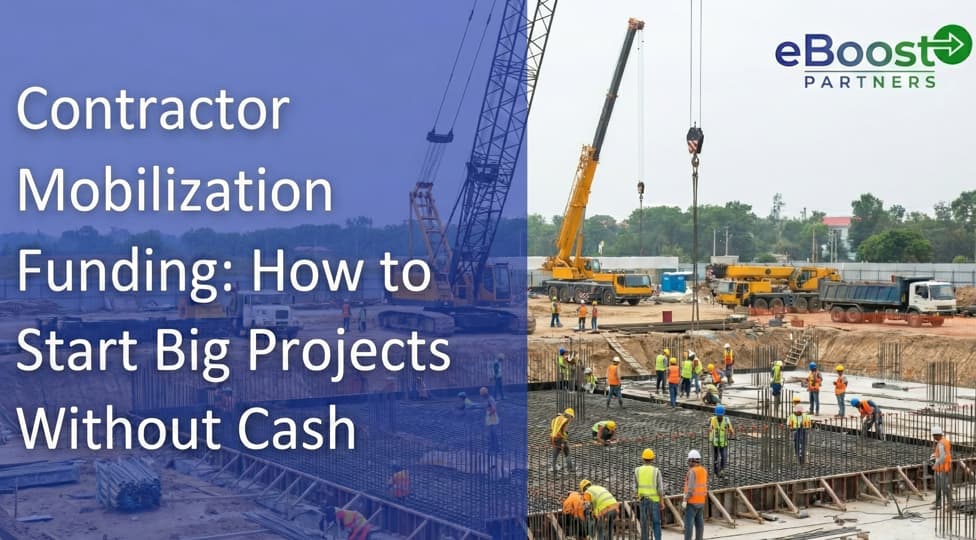
What Is Construction Mobilization Funding?
Let’s keep this simple. Mobilization funding is short-term working capital specifically designed to cover the upfront costs of starting a new construction project.
In a perfect world, clients would give you a 20% deposit the day you sign the contract. But in commercial and government construction? That rarely happens. You are expected to front the costs.
Mobilization funding provides you with the cash to deploy your resources – your mobilization – so you can hit the first milestone and submit your first Pay App (Application for Payment). Once the client pays that invoice, you use the proceeds to pay back the loan.
It’s not debt for debt’s sake; it’s a tool to unlock revenue.
Common Mobilization Costs Contractors Face
Before you can bill a dime, you usually have to spend a fortune. Here is exactly what this funding covers:
- Surety Bond Premiums: You often can’t step on site without a performance bond, which can cost 1-3% of the contract value upfront.
- Equipment Transport: Moving “Yellow Iron” isn’t cheap.4 Lowboy fees, permits, and fuel to move excavators to a new site can run thousands of dollars.
- Site Setup: Fencing, job trailers, temporary electric, and erosion control (silt fences).
- Labor: You have to pay your crew every Friday. Your client pays you… eventually. That payroll gap is dangerous.
- Materials: Steel, lumber, and concrete that need to be on-site immediately.
Types of Mobilization Funding Options
There is no “one size fits all” here. Depending on your contract type and your credit, one of these will fit your tool belt better.
Mobilization Loans
This is a standard term loan based on your business’s overall revenue. We look at your past jobs and current cash flow.
- Pros: You get a lump sum of cash to use for anything – payroll, fuel, or bonds.
- Eboost Terms: We offer these up to $2M with daily or weekly payments that match your cash flow cycle.
Contract Financing
This is specific to the job you just won. The lender looks at the creditworthiness of your client (the General Contractor or the Project Owner).
- How it works: If you won a contract with a reputable government entity or a massive GC, lenders feel safe advancing you money against that contract.
- Best For: Subcontractors taking on a job that is much bigger than their usual work.
Invoice Factoring
Also known as construction factoring, this allows you to sell your unpaid invoices for immediate cash.
- The Catch: You can only factor after you have billed. It doesn’t help with the initial Week 1 mobilization costs, but it solves the cash flow problem for Week 4 and beyond.
Line of Credit
Every contractor should have one of these. A business line of credit is a revolving safety net.
- Strategy: You get approved for $100,000. You draw $20,000 to move your equipment to the site. You pay it back when the first draw comes in. You pay interest only on what you used.
Who Qualifies for Mobilization Funding?
“Jordan, I’m a dirt guy, not a CPA. Can I get approved?”
Yes. Construction is a cash-intensive business, and we understand the cycles. We don’t expect you to have millions sitting in the bank – that’s why you’re calling us.
Typical Requirements:
- Signed Contract: You need a valid, executed contract or Purchase Order (PO) for the project.
- Time in Business: Usually 6+ months. We need to see you’ve completed jobs before.
- Revenue: Consistent deposits from past jobs.
- Credit: We specialize in business loans for bad credit. If your personal credit is 600 but you have a $500k signed contract with the City, we bet on the contract.
How Lenders Evaluate Mobilization Funding Requests
When you send us a file, here is what we are looking for:
- The Client Quality: Who is paying you? Is it the Federal Government (great), a massive national builder (good), or a homeowner with a sketchy credit history (risky)?
- The Project Scope: Can you actually do the work? If you are a painter and you just won a bridge building contract, we’re going to have questions. (Though we do fund bridge construction experts regularly).
- WIP Report: Your Work-In-Progress schedule tells us if you are over-extended. Do you have the manpower to handle this new job and your current ones?
Mobilization Funding vs. Traditional Loans
| Factor | Mobilization Funding (Eboost) | Traditional Bank Loan |
| Speed | 24 – 48 Hours | 60 – 90 Days |
| Collateral | The Contract / Cash Flow | Real Estate / Personal Assets |
| Paperwork | Minimal (Bank Statements + Contract) | Massive (3 Years Tax Returns, etc.) |
| Approval Odds | High (Even with bad credit) | Low (Strict FICO requirements) |
| Use of Funds | Flexible (Payroll, Materials, etc.) | Strict Restrictions |
Benefits of Mobilization Funding
- Bid on Bigger Jobs: You stop being limited by your bank account. You can bid on projects that are 3x your monthly revenue because you know you can get the funding to start them.
- Supplier Discounts: With cash in hand, you can pay suppliers upfront for materials, often negotiating a 2-5% discount. This can offset the cost of the financing!
- Reputation: You show up on Day 1 with the right equipment and crew. You hit your milestones. The GC loves you and invites you to bid on the next one.
Risks & Things to Watch Out For
Let’s be honest – borrowing costs money.
- Interest Rates: Mobilization loans are short-term and unsecured, so the rates are higher than a 30-year mortgage. You need to build this cost into your bid.
- The Retainage Trap: Remember that clients withhold 5-10% retainage. Don’t count on that money to pay back the loan. Plan your repayment based on the 90% progress payments.
How Fast Can You Get Mobilization Funding?
In construction, “soon” isn’t good enough. You need it now.
At eBoost Partners, our process is built for speed:
- Apply Online: Takes 5 minutes.
- Upload Docs: Bank statements and your signed contract.
- Offer: Usually within hours.
- Funding: Money in your account often the same or next day.
When Mobilization Funding Makes Sense
- The “Stretch” Project: You are a $1M/year company and you just won a $500k single contract.
- Government Work: The pay is guaranteed, but the red tape means you might wait 120 days for the first check.
- Concurrent Projects: You have three jobs starting at the same time and your working capital is spread too thin.
Winning the bid is only half the battle. Starting the job is the other half. Don’t let a temporary cash crunch stop you from taking your construction business to the next level.
You handle the dirt, the steel, and the concrete. Let us handle the capital.
Ready to break ground?
Disclaimer: The information in this article is for educational and informational purposes only and does not constitute financial advice. All funding products, rates, and terms are provided by eBoost Partners and are subject to application, credit approval, and our current underwriting criteria. Rates and terms are subject to change without notice.
FAQ: Construction Mobilization Funding
Do I need a signed contract to qualify?
For contract financing, yes. For a general working capital loan or line of credit, no – we just look at your past revenue history.
Can subcontractors get mobilization funding?
Absolutely. Subcontractors are often the ones squeezed the hardest because they are further down the pay chain. We fund electricians, plumbers, HVAC, and site-work subs every day.
Is mobilization funding expensive?
It is more expensive than a bank loan, but cheaper than losing the job. If the financing costs $5,000 but allows you to land a project with $50,000 in profit, the ROI is clear.
Can I use it for payroll and materials?
Yes. Once the funds are in your account, they are yours to use as needed to get the job moving. If you need dedicated funding strictly for materials, you might also look into purchase order financing.
How is it repaid?
At Eboost, we typically use automatic daily or weekly payments. This prevents a massive lump sum from hitting your account at the end of the month, smoothing out your cash flow.