
Construction Payroll Financing: Covering Labor Costs Between Draws
Jordan Rath is a professional finance writer at eBoost Partners with over seven years of experience in the commercial lending industry. A graduate of the University of Florida’s Warrington College of Business with a degree in Finance, he specializes in breaking down complex business lending topics to help entrepreneurs make smart, informed decisions.
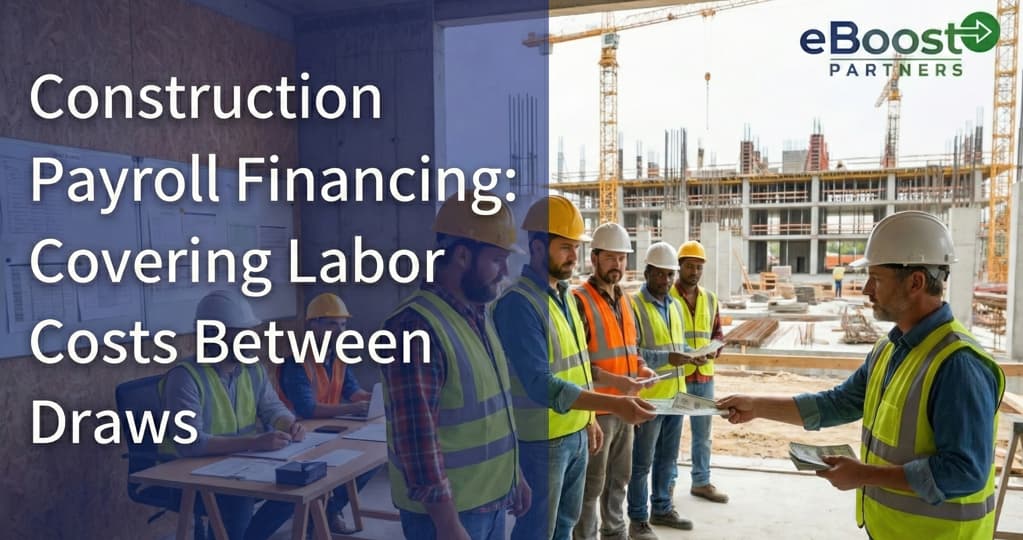
You’re sitting in your truck or staring at a spreadsheet in the job trailer. You know exactly what’s supposed to happen tomorrow morning: Payroll.
Your crew – the guys who have been busting their backs in the sun all week – expect their checks to clear. They have rent to pay and families to feed. But there’s a problem. The General Contractor (GC) promised the draw check would be here by Tuesday. It’s not here. Maybe it’s stuck in accounting, maybe the architect hasn’t signed off on the percentage of completion yet.
It doesn’t matter why it’s late. All that matters is that if you don’t pay your guys on Friday, they won’t show up on Monday.
In the construction industry, labor is the one expense you cannot negotiate. You can tell a lumber yard you’ll pay them next week. You can ask an equipment rental company for an extension. But you cannot delay payroll.
This disconnect – the brutal gap between weekly wage demands and monthly (or slower) reimbursement cycles – is what kills profitable construction companies. It’s called “The Float,” and it can drown you if you aren’t prepared.
That’s where construction payroll financing comes in. It is the safety net that ensures your team gets paid, your tax liabilities are met, and your reputation stays intact, regardless of when the client decides to cut the check.
At eBoost Partners, we specialize in construction business loans designed to bridge this specific gap. Whether you need $10,000 to cover a small crew or $500,000 for a massive commercial site, let’s talk about how to keep the checks clearing.
What Is Construction Payroll Financing?
Construction payroll financing isn’t a single product; it’s a strategy. It refers to any short-term funding solution used specifically to cover labor costs while waiting for accounts receivable (AR) to collect.
Unlike a mortgage or an equipment loan, this capital is working capital. It’s meant to be used, paid back, and used again. It smooths out the peaks and valleys of your cash flow.
Think of it this way: Your employees are your most important “equipment.” If you don’t put fuel (money) in the tank, the engine stops. Payroll financing is the emergency fuel can.
Why Contractors Struggle With Payroll Gaps
Why is this so hard? Why does every contractor I know, from startup to seasoned pro, sweat on Thursdays?
It usually comes down to three structural issues in our industry:
- Billing Cycles: You bill monthly. You pay weekly. Mathematically, you are financing the project for the owner for 30 days essentially for free.
- Retainage: The client holds back 5-10% of your money until the end of the job. That 10% is often your entire profit margin. You are effectively operating at cost until the punch list is done.
- Government Requirements: If you take on public works, you deal with the Davis-Bacon Act. This mandates Prevailing Wage rates, which can be double your normal pay rate. Plus, you have to submit Certified Payroll reports weekly. If you miss a report, they freeze your payments.
If you are struggling to visualize where your cash is getting stuck, it might be helpful to review how to calculate your operating working capital.
Payroll Costs Covered by Financing
When we talk about “funding payroll,” we aren’t just talking about the net check that goes to the employee. We are funding the Payroll Burden, which is often 20-30% higher than the wage itself.
Financing covers:
- Gross Wages: The hourly rate or salary.
- Payroll Taxes: FICA, Medicare, and state unemployment taxes. (Note: Failing to pay these is a federal offense. Never use tax money to float a job).
- Workers’ Compensation: In construction, these premiums are massive. Many carriers require large upfront deposits.
- Union Dues & Benefits: If you run a union shop, you have strict deadlines for pension and health contributions.
- Subcontractor Payments: Technically not “payroll” (they are 1099s), but just as critical. If the electrician walks off the job, the job stops.
Payroll Financing Options for Construction Companies
You have a few levers to pull. The right one depends on whether you have invoices ready to bill or if you are just starting the work.
Invoice Factoring
This is the most common tool for established contractors. You sell your unpaid invoices to a lender at a discount (usually 1-3%). You get cash immediately.
- Pros: It scales with your growth. The more you bill, the more funding you get.
- Cons: You can only factor completed work. It doesn’t help with mobilization (the first few weeks before you can bill).
- Resource: Learn more about invoice factoring.
Payroll-Specific Financing (Working Capital Loans)
These are short-term term loans based on your company’s historical revenue, not specific invoices.
- How it works: We see you average $100k/month in revenue. We lend you $50k to cover payroll for the month. You pay it back via daily or weekly deductions.
- Best For: Covering the “unbilled” gap – the work you are doing right now that you won’t invoice for another two weeks.
Line of Credit
This is the gold standard. An unsecured line of credit acts like a reservoir.
- Strategy: You draw $15,000 on Thursday to make payroll. You pay it back two weeks later when the check comes in. You only pay interest for those 14 days.
- Resource: Read our guide on the business line of credit.
Contract-Based Financing
If you have a signed government contract or a PO from a major GC, some lenders will advance funds against the contract value before you even start work. This is crucial for satisfying mobilization costs.
Merchant Cash Advance (Use With Caution)
If you need money tomorrow and have bad credit, this works. It’s fast, but expensive. Use it only for emergencies where missing payroll would cost you the contract.
Who Qualifies for Construction Payroll Financing?
“Jordan, I’m a drywaller, not a corporation. Can I get approved?”
Yes. We fund trades of all types, from HVAC businesses to massive bridge construction firms.
Typical Requirements:
- Time in Business: At least 6 months.
- Revenue: Steady deposits (we want to see that checks are coming in, even if they are sporadic).
- Payroll History: A record of paying employees (W-2) or subs (1099).
We specialize in business loans for bad credit. If you are great at building but bad at credit scores, we look at your contracts and cash flow instead.
How Lenders Evaluate Payroll Financing Requests
When you apply, we look for red flags that indicate a sinking ship versus a growing company.
- Tax Compliance: Do you have open tax liens? (We can sometimes work around this if you have a payment plan, but unpaid payroll taxes are a major issue).
- WIP Report: Your Work-In-Progress schedule shows us if you are underbilling or overbilling.
- Customer Concentration: Do you have one client who owes you 100% of your money? That’s risky. We prefer to see a mix of clients.
Payroll Financing vs. Traditional Business Loans
| Factor | Payroll Financing (Eboost) | Traditional Bank Loan |
| Speed | 24 – 48 Hours | 30 – 90 Days |
| Collateral | Future Revenue / Invoices | Real Estate / Equipment |
| Flexibility | High (Use as needed) | Low (Fixed lump sum) |
| Approval Odds | High (Revenue-based) | Low (Credit-based) |
| Repayment | Daily/Weekly (Matches cash flow) | Monthly (Large lump sum) |
Benefits of Construction Payroll Financing
- Employee Retention: Skilled labor is the scarcest resource in 2025. If you pay on time, every time, your guys stay. If you miss one week, they go to the competitor down the street.
- Tax Compliance: It ensures you have the cash to pay the IRS. The penalties for missing payroll tax deposits are severe – much higher than the interest rate on a loan.
- Growth: You can take on that second big project knowing you have the funds to cover the doubled labor force.
Risks & Common Mistakes
Using Payroll Funds for Materials
Don’t take a loan meant for labor and spend it on lumber. Labor has to be paid now. Lumber yards might give you terms. Keep your buckets separate.
Ignoring the Cost of Capital
Financing costs money. If your profit margin on the job is 5%, and the loan costs 6%, you are working for free. Make sure your bid includes enough margin to cover financing costs. (Check our guide on net revenue vs net income to calculate this correctly).
Spot Factoring Addiction
Factoring is great, but don’t get addicted to spot factoring every single invoice if you don’t need to. It cuts into your margins. Use it strategically.
How Fast Can You Get Payroll Funding?
Payroll waits for no one.
At eBoost Partners, we operate on contractor time.
- Apply Online: It takes minutes.
- Submit Docs: Bank statements and a payroll summary.
- Funding: We can often wire funds the same day or next day.
We know that if you call us on Wednesday, you need the money by Friday morning.
When Payroll Financing Makes Sense
- The “Big Start”: You just ramped up from 5 guys to 20 for a new job, but the first check is 60 days out.
- The Retainage Holdup: The job is done, but the client is holding $50,000 in retainage, and you still have overhead to pay.
- The Surprise Change Order: The client added $20,000 of work. You have to do it now, but the paperwork to get paid for it will take weeks.
Your crew builds the building. You build the business. Don’t let a slow-paying client threaten the foundation of your company.
Keep your workers happy, your taxes paid, and your projects moving.
At eBoost Partners, we are the silent partner that ensures payday happens, no matter what.
Disclaimer: The information in this article is for educational and informational purposes only and does not constitute financial advice. All funding products, rates, and terms are provided by eBoost Partners and are subject to application, credit approval, and our current underwriting criteria. Rates and terms are subject to change without notice.
FAQ: Construction Payroll Financing
Can payroll financing be used for union labor?
Absolutely. In fact, it’s critical for union shops because missing a benefit payment can trigger an audit or a work stoppage. We understand the urgency of union obligations.
Do I need invoices to qualify?
For factoring, yes. For a line of credit or working capital loan, no. We can lend based on your contract or historical revenue, allowing you to fund payroll before you invoice.
Is payroll financing expensive?
It depends on the product. A line of credit is usually the cheapest. Spot factoring or merchant cash advances are more expensive but faster. The cost should be viewed as “insurance” against losing your crew.
Can subcontractors use payroll financing?
Yes. Subcontractors (electricians, plumbers, drywallers) are our most common clients because they are often squeezed the hardest by GCs.
How is it repaid?
At Eboost, we typically use automatic weekly payments. This aligns perfectly with your payroll cycle. You pay your guys weekly; you pay back the loan weekly. It keeps your cash flow rhythm consistent.